Prispevek na konferenci · 2024
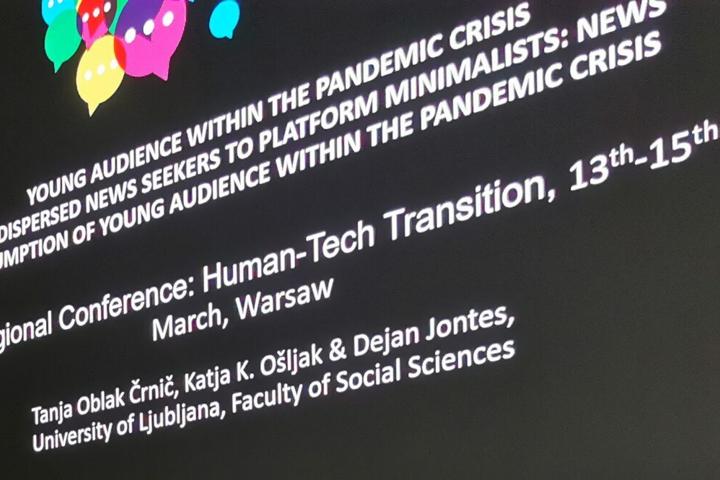
From dispersed news seekers to platform minimalists: news consumption of young audience within the pandemic crisis
- Objavljeno v
- Human Tech Transitions: Crises in Mediatized Politics, Society & Economy
- Leto izida
- 2024
- COBISS
- COBISS.SI-ID 189450755
- Projekt
- Medijski repertoarji mladih
Povzetek
Several studies on the media repertoires of young people show some overarching trends. At the same time, research confirms that young people do not assign media to specific functions, but use platforms multifunctionally, especially as they get older (Wimmer & Wurm, 2021). More narrowly, some studies show that the development of information media resembles a patchwork process in which not only peer groups but also family and school environments are important contextual factors. However, such media constellations are not fixed and unchangeable formations. Pandemic closure in this sense brought severe destabilization of everyday routines and many of them were intensively translated into online contexts, also for the kids (Oblak & Brečko, 2022). Ytre-Arne (2019) argues that understanding biographical change in everyday life is central to understanding changing media use, where the media repertoire model, with its attention to everyday media use and social figurations, is valuable for understanding how biographical events might affect media use. The disruptions, however, reach beyond Covid crisis and are linked to the characteristics of social media in general. Consequently, to understand young audiences, the technological specificity and uses of a medium are not as important as the conceptualisation of digital media as an integrated communicative environment. Their sociability is based on permanent activity and affective engagement and is framed by the algorithmically produced regime of visibility and the promise of liveness on the platforms.
The concept of media repertoires—specifically, news repertoires—has been at the forefront of research on the choices of audiences in complex media environments in the last 15 years (Edgerly et al., 2018; Edgerly & Vraga, 2020; Peters et al., 2022; Wimmer & Wurm, 2021). Cross-sectional media research has gained new momentum also due to Couldry and Hepp’s (2017) thesis on deep mediatization, and this research has further popularised media repertoires, which highlight the importance of the interconnected configuration of media (Hasebrink & Domeyer, 2012). More importantly, resisting permanent social media engagement, which has become an important factor in news consumption of this age group, represents a practice of distinction and an ideological statement. However, Bucher (2020) argued that this choice is no longer a viable option because our ontological conditions imply a techno-social existence, and even absence provides platform algorithms with important information about the person abstaining. Moreover, since the logics of datafication and predictive analytics make it difficult to opt out of digital platforms and services, “refusing to connect or temporarily opt[ing] out is a form of connection too” (Bucher, 2020, pp. 610–611).
With the above-mentioned theoretical considerations and context, the paper aims to focus on the research question, what were the main characteristics of news repertoires of young audiences in the context of destabilized everyday life. More narrowly, the aim of the paper is to critically investigate, how such biographical disruption on the one hand and specific communication environment within several media platforms on the other affected news consumption among the teens.
In searching for the answers, the paper refers to the results of a mixed method approach to media repertoires among the youth: first, the news media habits are presented, based on a qualitative focus groups method on a sample of 67 teenagers from 12 to 19 years old, which was conducted within the second wave of Covid-19 epidemic closure in 2021 in Slovenia. The media mapping method complements the data in group interviews with information at an individual level. Inspiration for it comes from previous discussions (see e.g. Hasebrink & Domeyer, 2012), which examine methodological approaches for exploring media repertoires and communication configurations in deeply-mediated everyday life (Hepp, 2019). Each participant draw their own personal media network and categorised personal media choices as a response to five different questions: Which media 1) are the most important; 2) are used for information gathering; 3) are preferable for keeping contacts and socialising; 4) are for fun, relaxation and free time and 5) are for creating, making or expressing themselves. Mapping is a replacement for media diaries, which research shows to be ineffective among children and teenagers, or less reliable (see Kirsh, 2010). Photos of the sketches were forwarded via Zoom or email.
Analysis of youth's personal media sketches for the entire sample of 59 sketches, provides us with insight at many levels: which media or devices are most important to teenage youth in general, and which are the most important for their information seeking. Even a preliminary cross-section analysis of media sketches suggests that media preferences mask complex relationships within the generation.
-
Distant learning as news seeking: The first block or group consists of those respondents, who positioned their primary news access to two platforms for online learning, namely MS Teams or Zoom. This means that their understanding of being informed is in major sense related to school obligations and tasks. “News” for this group is not so much related to a concrete public media event, but more to their own primary “care”, that is school. This was relevant for a small group of girls attending primary or secondary school, which far from the others inform themselves through distant learning tools. In this sense it is a very homogeneous - girlish – and niche news repertoire.
-
Cross-social media news repertoire: The second repertoire belong to a larger group of mostly high-school students, who are totally different from the first group as they highly prefer three very specific and very much diverse online tools: Discord, Google and Instagram. However, similarly to the first group, they never mentioned the phone as a single device for news seeking.
-
YouTube fans: The third news repertoire is in contrast much more narrowly structured as it belongs to those students who prefer one single and very concrete media platform or channel – namely, the YouTube. This very special news repertoire belongs primarily to boys from primary schools, who on the other hand are not the fans of Snapchat or FB messenger. Their personal news consumption relay on one channel only; that is the reason why we proposed to name them YouTube fans.
-
Snapchat lovers: In a way similar, but in relation to concrete media platform very different is the fourth group, which consist of primarily high-school students, who highly prefer Snapchat as a news resource.
-
Phone as a device for news: Fifth, and very specific type of news repertoires seems to belong to girls, coming primarily from high schools. Their main difference to all the previous ones is that instead of a certain platform, concrete portal or online tool, they are internally similar in choosing a concrete device as the most wanted news channel: namely, all together they mentioned their phone as the most important news device.
-
Dispersed news seekers: The last and the largest group seem to consist of younger girls, who mostly come from primary school. In their media preferences and online tools, they seem to be “dispersed all around”. Their news consumption is diverse in the sense that they are, in comparison to previous types, not consistently attached to a singular medium or concrete combination of devices and tools.
A mere preliminary cross-sectional data analysis of media sketches implies that complex relationships are hidden in the background of the selected preferences. Here, the educational context already hints at the specifics of media choice, but cross-sectional analysis is needed along with data within family domains, even if these are relatively homogeneous in our sample. However, our findings also confirm, at least in part, the results of previous research on news repertoires and information behaviour. For example, Prandner and Glatz's (2021) quantitative study of the Austrian population showed it's only younger people who are online-only users (2022, p. 61), representing a small minority within the general population whose news consumption depends only on online platforms. A Danish study (Peters et al., 2022) identified five different news repertoires among young adults: the online traditionalist, the in-depth audiophile, the digital news seeker, the interpersonal networker and the non-news information seeker, all of whom rely heavily on several new media platforms, which on the one hand undermines the importance of traditional news media players, but on the other hand also shows that, apart from Facebook, other social media such as YouTube, Instagram and Twitter/X are not important sources of information.
Since young people start to develop their news habits in early adolescence (Buckingham, 2000; Marchi, 2012; Russo & Stattin, 2017), the understanding of their news consumption within specific social contexts can also explain an anticipation of their future news and media habits (LaRose, 2010; Peil & Spaviero, 2017). Therefore, such findings bring also some practical implications, especially in relation to the educational practices and the perceived importance of digital competences for the youth. The findings that online platforms do not introduce new regimes of social boundaries but enhance the existing distinctions in cultural practices should be considered also in educational policies, especially on the level of the curriculum for digital media education.